Thermal Imaging Leak Detection in Marietta & Metro Atlanta
Thermal imaging uses an infrared camera to detect surface temperature differences that hidden water can cause — a cooler patch from evaporating moisture, or a warm streak from a leaking hot-water line beneath a floor or behind a wall. It’s one of several diagnostic tools we use, most often alongside acoustic detection and pressure testing, to narrow down a leak’s location before anything is opened.
- Same-day in most cases
- No jackhammering to find it
- Written report
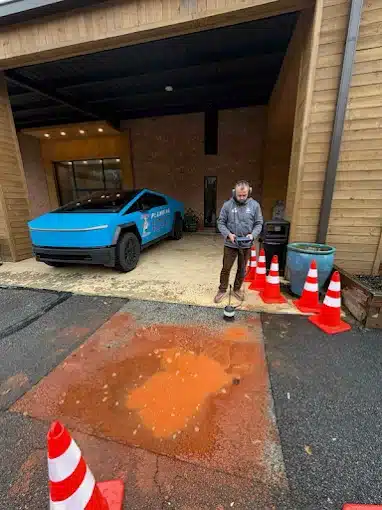
Signs You Need a Thermal Imaging
- A warm patch on flooring or a wall, especially with no obvious heat source nearby
- Unexplained moisture, staining, or discoloration with no clear point of origin
- A musty smell without a visibly wet area to trace it to
- A suspected leak location that hasn't been narrowed down by other methods
- Situations where opening a wall, ceiling, or floor to look for a leak needs to be avoided if at all possible
How Thermal Imaging Works — and Where It Fits In
A thermal imaging camera reads infrared radiation and converts surface temperature differences into a visible image, without any physical contact with the surface. Water changes the temperature signature of what it touches — a leaking hot water line often shows up as a warm streak or patch following the pipe’s path, while evaporating moisture from a cooler leak can appear as a cooler-than-surrounding area on flooring, drywall, or ceilings. This makes thermal imaging useful for narrowing down a search area quickly, especially over a large section of floor or wall, before more targeted testing is used.
Thermal imaging works best as a confirming and narrowing tool, not a standalone diagnosis. It reads surface temperature only — it cannot see through a slab, wall, or floor covering the way a camera can see inside a pipe — and a temperature difference on its own doesn’t prove a leak is present. HVAC vents, direct sunlight through a window, insulation gaps, and even a difference in flooring material can all create a temperature variation that looks similar to a leak signature. That’s why thermal imaging is typically used alongside acoustic detection, pressure testing, or meter testing: it helps point toward the most likely area, and those other methods confirm whether a leak is actually there.
Why It Matters
Why It's Worth Using — and Where It Has Limits
The main advantage of thermal imaging is speed and coverage: it can scan a large section of floor or wall almost instantly and flag areas worth a closer look, which is especially useful on larger properties or when a leak’s general area isn’t yet known. The limitation is that it’s a surface-reading tool — it’s most reliable for hot-water-line leaks, where the temperature contrast is strongest, and less reliable for cold-water leaks, where the temperature difference from the surroundings may be minimal or short-lived. Ambient conditions like a running HVAC system, direct sunlight, or recent activity in the space can also affect what shows up, which is why results are always read in context and combined with other testing rather than used alone.
Next Steps
What Happens After a Thermal Scan
If a thermal scan identifies an area of interest, the next step is usually confirming it with acoustic detection, pressure testing, or meter testing before treating it as a confirmed leak location. Once the location is confirmed through this combination of methods, we’ll walk you through what was found and what the repair options look like before any decision is made about opening a wall, floor, or ceiling.
Same-day Availability
Same-day inspections are often available depending on scheduling, and 24-hour emergency service is available for situations that can’t wait.
If your situation runs deeper
If your situation turns out to involve a broader plumbing issue, we also handle Water Leak Detection, Underground Water Leak Detection, and Commercial Leak Detection for larger properties.
Get it Located Today
Tell us what you are seeing and we will call you back.
Or call (470) 454-5051 — 24-hour emergency line.
Thermal Imaging FAQs
Can a thermal imaging camera see through a wall to find a leak?
No. A thermal camera reads surface temperature only — it doesn’t see through a wall, floor, or slab the way an X-ray or a sewer camera sees inside a pipe. It detects the temperature difference that water leaves on the surface, which is what makes it useful for narrowing down a search area rather than proving a leak by itself.
Is thermal imaging accurate for finding water leaks?
It’s accurate at detecting real temperature differences, but a temperature difference alone doesn’t always mean there’s a leak — HVAC vents, sunlight, and building materials can create similar readings. For that reason, thermal imaging is used to narrow down a likely area, and the leak is confirmed with acoustic detection, pressure testing, or meter testing before any repair decision is made.
Does thermal imaging work on cold water line leaks?
It can, but it’s generally more reliable on hot water line leaks, where the temperature contrast against the surrounding surface is stronger and longer-lasting. Cold water leaks may still show a cooler patch from evaporation, but the signature can be subtler and more affected by ambient conditions.
Will thermal imaging alone tell you exactly where to cut into a wall or floor?
Not on its own. Thermal imaging identifies a likely area of interest, and that area is then confirmed with acoustic detection, pressure testing, or meter testing before any access decision is made. Using thermal imaging together with these other methods is what allows access, if needed, to be targeted rather than exploratory.
How long does a thermal imaging inspection take?
A thermal scan itself is quick — often just minutes to cover a room or section of flooring — but it’s typically performed as part of a broader inspection that includes other diagnostic methods, which is what determines the total visit time.
What's the difference between thermal imaging and acoustic leak detection?
Thermal imaging reads surface temperature to spot patterns consistent with hidden moisture or a hot-water leak. Acoustic detection uses specialized listening equipment to hear the sound signature of water escaping under pressure through a pipe. They work well together because they rely on different physical signals — one visual, one auditory — to confirm the same leak location.